
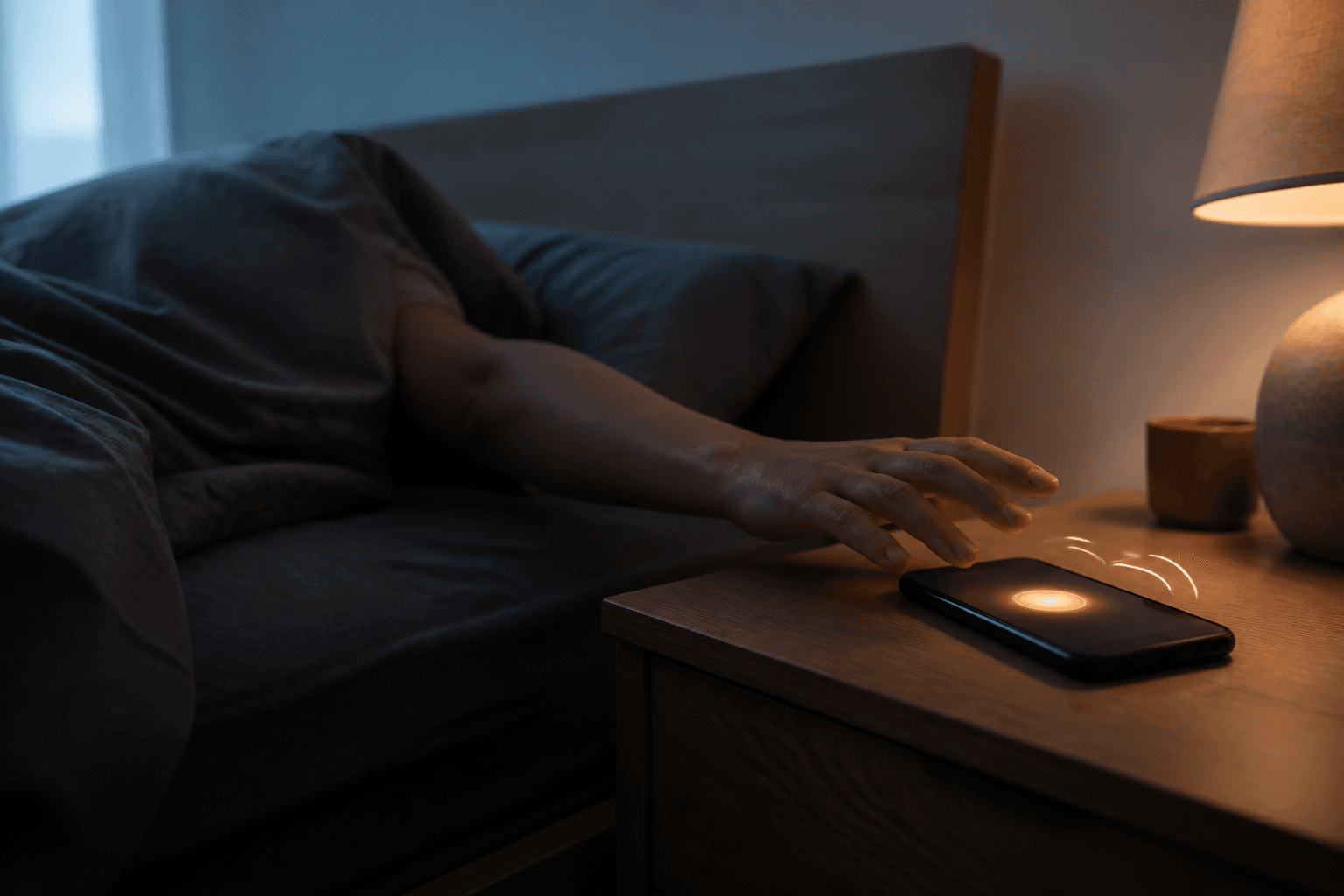
Yes, it is possible to dismiss an alarm while only partly awake and remember little or nothing later. The most likely everyday explanation is the transition from sleep to wakefulness, not that you made a fully alert decision and somehow erased it. One missed memory cannot tell you exactly what happened, and it does not by itself diagnose a sleep disorder.
The practical problem is that a bedside alarm usually asks for a movement you have repeated hundreds of times. If one tap ends the sound, the action may finish before your waking brain has had to pay sustained attention. The solution is to improve both sides of the morning: give yourself enough sleep, then make dismissal require one short, deliberate action.
You are awake, but not fully alert yet
Sleep inertia begins as soon as you wake
Sleep inertia is the temporary grogginess, disorientation, and reduced performance that follows waking. Research reviews find that its strongest effects are usually in the first part of the wake-up period. Alertness often improves quickly, but some measures can take longer to return to a fully awake baseline.
That transition is not all-or-nothing. Hearing a sound, reaching toward it, and pressing a familiar control do not prove that the attention and judgement needed for a considered decision have fully returned.
Sleep loss can make the transition harder
Sleep inertia tends to be more severe after insufficient sleep and when waking at a low point in the body clock. Waking from deeper sleep may also matter, although studies do not give one simple rule that predicts every difficult morning. If this happens mainly after short nights, begin with the sleep schedule rather than looking for a more aggressive alarm sound.
Why there may be no clear memory of the alarm
A familiar action demands very little attention
A phone beside your hand creates the shortest possible path from sound to silence. You do not need to sit up, look around, or make a new choice. Sleep-inertia research shows that memory, calculations, decision-making, and attention can all be impaired after waking. A routine swipe is therefore a poor test of whether you are genuinely ready to stay awake.
Weak attention can mean weak recall
Forming a useful memory depends on paying attention while an event happens. If the alarm is silenced during a brief, groggy arousal, the event may never become a durable memory you can retrieve later. That is a plausible explanation for finding a silent phone and having no recollection of touching it, but it is not possible to confirm the cause from the missing memory alone.
This is not automatically sleepwalking
Confusional arousals are a type of partial awakening from non-REM sleep. Someone may appear confused, respond slowly or incoherently, then return to sleep with little memory of the episode. They are different from an ordinary moment of groggy alarm dismissal, and a clinician—not an alarm app—should assess recurrent or concerning episodes.
How to interrupt automatic alarm dismissal
Move the alarm beyond arm's reach
Place the phone somewhere that requires you to sit up or stand, while keeping the route clear and safe. Even a few steps add orientation and movement before the sound stops.
Replace one tap with one deliberate task
Use a short maths or memory task if the problem is an automatic swipe. If you switch off the alarm and return to bed, use an object or camera task located away from the bedroom. Choose something safe and realistic enough to complete every morning.
Use one primary alarm and a considered backup
A chain of alarms can become rehearsal for repeated dismissal. Set a realistic wake time, test the primary alarm while awake, and add a backup only where the consequences of missing it justify one.
Protect the sleep before the alarm
Most adults need at least seven hours of sleep, though individual needs vary. Work backwards from your wake time, allow time to fall asleep, and keep the schedule broadly consistent across the week.
Add light and a next action
Once the alarm is dismissed, turn on a light or open the curtains and begin one small action such as drinking water or going to the bathroom. The goal is to avoid an empty pause in which getting back into bed is the easiest option.
Record what happens for seven mornings
Note bedtime, estimated sleep, whether you remember the alarm, the task you completed, and whether you returned to bed. Change one weak point after a week instead of changing the entire setup after every difficult morning.
When to speak to a healthcare professional
An occasional blank after a short night is different from frequent, prolonged, or unsafe confusion. Seek medical advice if this keeps happening even when you allow enough time for sleep, or if someone observes that you are difficult to wake, speak or behave unusually, leave the bed, or remain confused for several minutes.
Also speak to a healthcare professional if you have marked daytime sleepiness, loud snoring, breathing that stops and starts, gasping or choking during sleep, frequent waking, morning headaches, or difficulty concentrating. These can be symptoms of sleep apnoea, which needs proper assessment and treatment.
If waking on time is essential for medication, caring duties, travel, or safety-critical work, use an appropriate tested backup. Do not rely on a new alarm setup until it has worked reliably on ordinary mornings.
Common questions
Can you really turn off an alarm while asleep?
You need to arouse enough to hear and respond to the alarm, but that does not mean you are fully alert. A partial or very groggy awakening can be enough for a familiar movement while leaving attention and later recall weak.
Will a louder alarm stop this happening?
A louder sound may help if you do not hear the alarm, but it does not change a dismissal action that can be completed from bed. Test volume and audio routing while awake, then focus on what you must do after the alarm begins.
Should I use a maths or movement mission?
Match the task to what normally goes wrong. A short maths or memory task adds attention. An object or camera task can move you away from bed. A physical task can add movement, but it must be safe for your health, room, and level of coordination just after waking.
What if I hear the alarm but always go back to sleep?
That is a slightly different problem. Put the required action away from bed, add light immediately, and decide the first step of your routine before going to sleep. Our guide to stopping the snooze habit covers how to plan those first minutes out of bed.
Sources and further reading
- Sleep inertia: current insights
- Waking up is the hardest thing I do all day: Sleep inertia and sleep drunkenness
- Parasomnias: An Updated Review
- Cleveland Clinic: Confusional Arousals
- CDC: About Sleep and Your Heart Health
- NHS: Sleep apnoea
This guide provides general information and should not replace medical advice. We checked it against the sources above on 26 August 2026.